


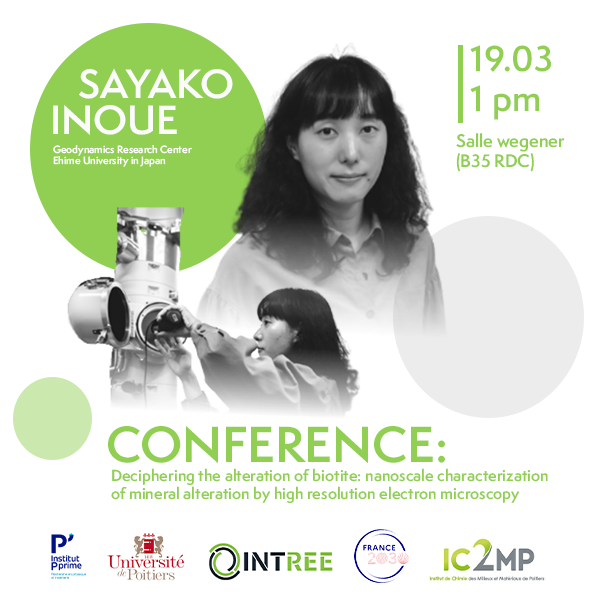
« Deciphering the alteration of biotite : nanoscale characterization of mineral alteration by high resolution electron microscopy »
« The alteration of minerals plays an important role in biogeochemical cycles. The alteration process is often associated with the formation of clay minerals. To understand the underlying reaction mechanisms, detailed characterization of alteration products is essential. High resolution transmission microscopy (HRTEM) observation enables identification of structural alteration mechanisms at a near-atomic scale. However, nanoscale to atomic scale chemical analysis remains challenging with conventional transmission electron microscope because the alteration products are typically highly beam-sensitive. This gap between the resolution of the structural and chemical analyses leaves ambiguity in understanding the reaction mechanisms, requiring optimization of conventional chemical analysis methods.
In this study, we combined the high-resolution quantitative chemical mapping using the annular energy dispersive X-ray spectrometer (EDS) equipped with scanning electron microscope (SEM) and HRTEM to understand the process of biotite alteration in the Toyama breccia pipe, Yamanashi, Japan. Nanoscale characterization of biotite revealed that a complex process of alteration. Three types of alteration were identified: 1) depletion of K accompanied by the oxidation of Fe(II), 2) incorporation of Fe and Mg in the interlayer and formation of hydroxy-interlayered vermiculite-type structure, 3) depletion of cations in the 2:1 layer. Each type of alteration will be discussed in detail during the presentation. Our results demonstrated the significance of the nanoscale to atomic scale characterization of altered minerals for clarifying the reaction mechanism. »
Salle Wegener, RdC, Bâtiment B35 – Jeudi 19 Mars 13h00
Informations complémentaires
Dr. Sayako Inoue attended Chiba University, and after graduating from the Department of Earth Sciences in 2011, she went on to study at the Graduate School of Science at the University of Tokyo. Thereafter, she was involved in the Department of Geosciences at Virginia Polytechnic Institute and State University as a postdoctoral researcher from 2016 to 2019. She then took up a position as a project researcher at the University of Tokyo in 2019, before moving in 202 1to her current post : Assistant Professor at the Geodynamics Research Center, Ehime University, Japan.